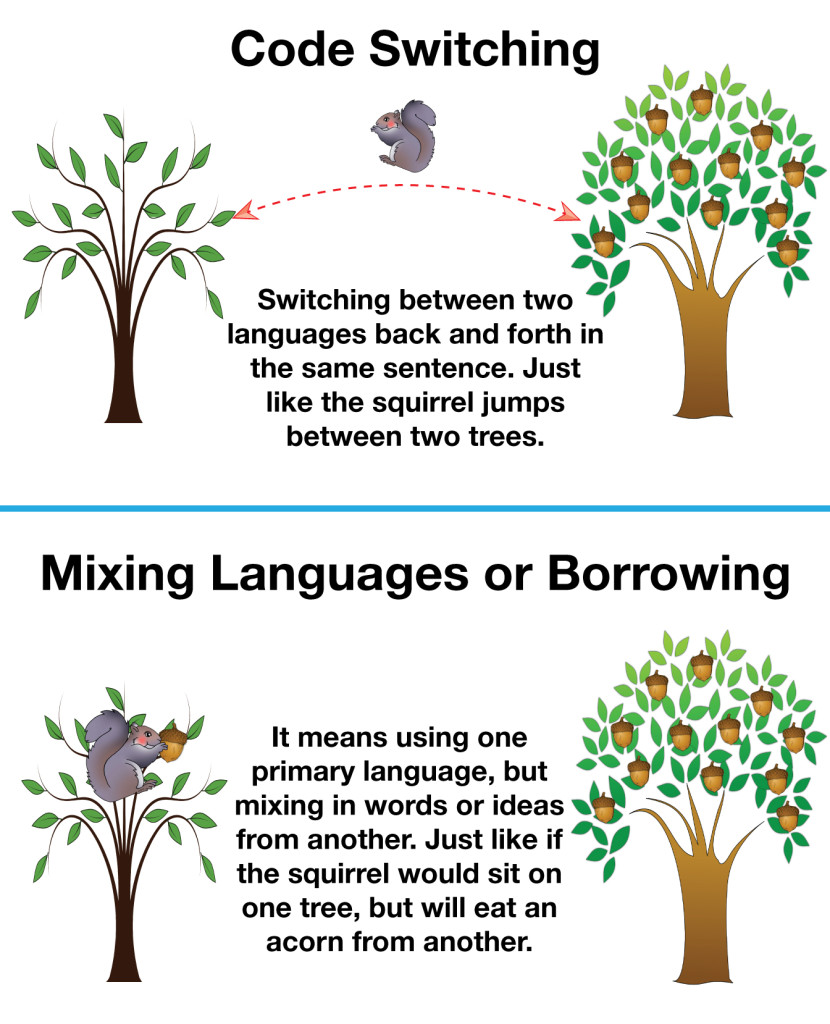
Shana Poplack, one of the most
recognized scholars in this topic, defines that “Code Switching refers to the
mixing by bilinguals (or multilinguals), of two or more languages in discourse,
often with no change of interlocutor or topic”, which means that people
participating in a conversation never arrange code switching. They do it
intentionally in order to convey the message they want to express. There are
many reasons why people would code switch, but among the most recurrent ones we
find that it is used to emphasize an idea, to add expression and personality
and to show identity. Code switching
does not happen uniquely in everyday conversations, but also in media.
Now, if we had to trace the history
of the term, we could go way back to the beginning of bilingual communities
worldwide. However, it was not until the last decades that this term begun to
attract the attention of scholars. That is why we can go back to the 70’s when
code switching was considered as something random and deviant because we have
to bear in mind that this was not something that could have been,
linguistically speaking, well seen. .
Then, as more research was carried
out, Poplack came over with a new term that explained better how code switching
worked. That term is the Equivalence
constraint that suggests that the two constituents in CS are ordered in the
same way in both languages. Which means that in the language 1 you were
supposed to use a noun and you want to codeswitch it, you had to use a noun in
language 2 as well. Here’s an example: “I love you porque eres amable” can be
the same as “I love you because you are kind” Nonetheless, some scholars refuted
this theory because there are some syntactic structures that cannot be applied
such as the adjectives in English and Spanish.
After, in the 90’s MacSwan
restricted CS at structural sites only. Code switching could be done only in
function words such as prepositions or conjunctions, but not in content words
such as nouns or verbs.
Yet, that is not all, because
nowadays scholars are also talking about CS, but not only in regard to the
linguistically side of it, but they are starting to inquire if it is a
psycholinguistic or a sociolinguistic feature.
Chad Nilap suggests that “Code
switching is accomplished by parties in interaction (interlocutors), and the
meaning of their behavior emerges from the interaction (…) therefore, it cannot
specify broad functions of language alternation, nor define the exact nature of
any code prior to interaction.”
Comentarios
Publicar un comentario